
The design principle
When the Commission on the Unification of Pronunciation met in 1913, it needed a phonetic notation that would look like Chinese rather than like a foreign import. The solution was elegant: for each sound, find a character already pronounced with that sound, then strip it back to a few strokes.
This is the same principle behind Japanese kana, which were derived from Chinese characters in much the same way: か from 加, き from 幾. Zhuyin was designed with that precedent explicitly in mind.
The practical consequence is that every symbol is a real fragment of the writing system, not a new invention. Learners who already read some Chinese often find the symbols easier once they can see the character hiding inside.
The 21 initials
| Symbol | Sound | From | Which means |
|---|---|---|---|
| ㄅ | b | 勹 bāo | to wrap, the archaic form of 包 |
| ㄆ | p | 攵 pū | to tap or knock, a variant of 攴 |
| ㄇ | m | 冂 → 冪 mì | a cloth covering something |
| ㄈ | f | 匚 fāng | an open-sided box |
| ㄉ | d | 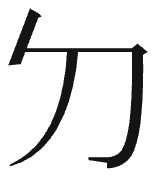 dāo, archaic form of 刀 dāo, archaic form of 刀 | a knife |
| ㄊ | t | 𠫓 tū | to emerge suddenly, an upside-down 子 |
| ㄋ | n | 𠄎 → 乃 nǎi | thereupon |
| ㄌ | l | 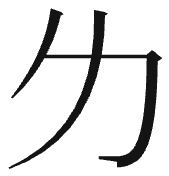 lì, archaic form of 力 lì, archaic form of 力 | strength, originally a plough |
| ㄍ | g | 巜 guì | a drainage channel, ancient form of 澮 |
| ㄎ | k | 丂 kǎo | obstructed breath, ancient form of 考 |
| ㄏ | h | 厂 hǎn | an overhanging cliff |
| ㄐ | j | 丩 jiū | to entwine, ancient form of 糾 |
| ㄑ | q | 𡿨 quǎn | a small stream between fields |
| ㄒ | x | 丅 xià | below, the ancient form of 下 |
| ㄓ | zh | 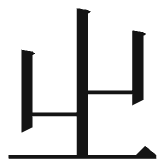 zhī, archaic form of 之 zhī, archaic form of 之 | to go |
| ㄔ | ch | 彳 chì | a step, the left half of 行 |
| ㄕ | sh | 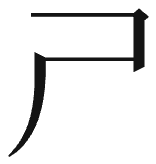 shī, archaic form of 尸 shī, archaic form of 尸 | a reclining body |
| ㄖ | r | 日 rì | the sun |
| ㄗ | z | 卩 jié | a bamboo tally, ancient form of 節 |
| ㄘ | c | 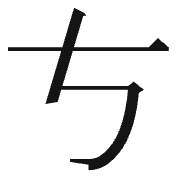 qī, archaic form of 七 qī, archaic form of 七 | seven, borrowed for its old reading in 疵 |
| ㄙ | s | 厶 sī | private, the ancient form of 私 |
The 3 medials
ㄧ is the one symbol that changes orientation. In vertical text it is written horizontally, as 一 is; in horizontal text it is turned upright so it does not vanish into the baseline.
| Symbol | Sound | From | Which means |
|---|---|---|---|
| ㄧ | i | 一 yī | one |
| ㄨ | u | 㐅 → 五 wǔ | five, a crossed tally mark |
| ㄩ | ü | 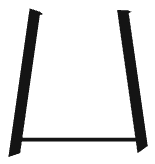 qū, archaic form of 凵 qū, archaic form of 凵 | a container open at the top |
The 13 finals
| Symbol | Sound | From | Which means |
|---|---|---|---|
| ㄚ | a | 丫 yā | a forked branch |
| ㄛ | o | 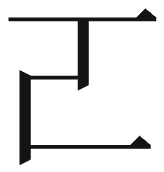 hē hē | to breathe out, a mirrored 丂 |
| ㄜ | e | ㄛ | the exception, see below |
| ㄝ | ê | 也 yě | also |
| ㄞ | ai | 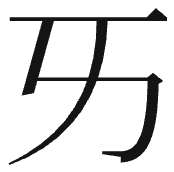 hài, archaic form of 亥 hài, archaic form of 亥 | the twelfth earthly branch |
| ㄟ | ei | 乁 yí | to flow or extend |
| ㄠ | ao | 幺 yāo | tiny, a single silk thread |
| ㄡ | ou | 又 yòu | again, originally a right hand |
| ㄢ | an | 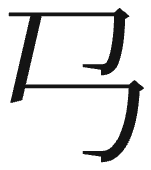 hàn hàn | to bloom |
| ㄣ | en | 乚 yǐn | to hide, ancient form of 隱 |
| ㄤ | ang | 尢 wāng | lame, a person with a bent leg |
| ㄥ | eng | 𠃋 gōng | the upper arm, ancient form of 肱 |
| ㄦ | er | 儿 → 兒 ér | a child |
The one exception: ㄜ
Every other symbol comes from a character. ㄜ does not. It was created in 1920, seven years after the rest, by adding a stroke to ㄛ.
The reason is that the original 1913 set used a single symbol, ㄛ, for two sounds that had been treated as one. They are not one: the vowel in 婆 (pó) has rounded lips, while the vowel in 鵝 (é) does not. Once the distinction was formally recognized, a new symbol was needed, and rather than hunt for another character the commission simply modified the existing one.
This is why ㄜ looks like ㄛ with an extra mark. It is the only place in the system where the shape encodes a relationship between sounds rather than a borrowed character.
Does knowing this help you learn?
Honestly, it depends. If you already read Chinese characters, seeing 日 inside ㄖ or 力 inside ㄌ gives you a hook that pure shape-memorisation does not, and several of the source characters share the symbol’s sound, which doubles as a mnemonic.
If you do not read characters yet, the etymology is interesting but not load-bearing. You will learn the 37 shapes faster by hearing them repeatedly on the interactive chart, or with the app, than by studying where they came from. Come back to this page later; it is more satisfying once the symbols are already familiar.