
Why this catches foreign parents off guard
Most foreign parents in Taiwan assume the barrier is Chinese characters, so that is what they brace for. It is not the first barrier. Taiwanese first graders spend their opening weeks of school on zhuyin alone, before a single graded character appears in the textbook, and every character they meet after that keeps its zhuyin printed alongside it for years. The system you actually need to read first is the phonetic one, not the logographic one.
This trips up two groups equally. Parents who never studied Mandarin at all cannot read either layer. But parents who did study Mandarin, often through pinyin, in Manila, Los Angeles or Tokyo before moving to Taiwan, hit a different wall: they can often speak the language and still cannot read a word of their child’s textbook, because everything in it is keyed to a phonetic alphabet they never learned.
The good news is that the actual task in front of you is narrow. You are not trying to become literate in Chinese. You are trying to sound out what your child is already being taught to sound out, using the same symbols the school uses.
What your child’s textbook actually looks like
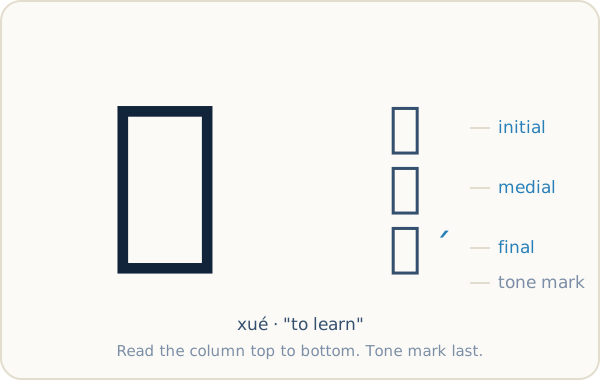
Open a Taiwanese elementary Chinese textbook (國語, "national language") and every character carries a small vertical column of zhuyin beside it, the initial on top, then the medial, then the final, with the tone mark tucked in beside the last symbol. It functions exactly like furigana in a Japanese children’s book: the character carries the meaning, the small annotation beside it carries the pronunciation.
This matters for you in one specific way: you do not need to recognize the character to sound out the word. If you can read the zhuyin column, you can pronounce whatever it is attached to correctly, even if the character itself means nothing to you yet. That is the entire shortcut this guide is built on.
The homework vocabulary you will keep seeing
A handful of terms show up on almost every page of homework and in almost every note home. None of them are explained to you, because the school assumes a Taiwanese parent already knows them. Here is what they mean.
| Term | Pronunciation | What it means for you |
|---|---|---|
| 注音符號 | zhùyīn fúhào | The zhuyin system itself: the 37 symbols this whole guide is about. |
| 生字 | shēngzì | This week’s new vocabulary characters, usually copied out several times with their zhuyin attached. |
| 造詞 | zàocí | An exercise asking your child to build a new word from a given character. |
| 造句 | zàojù | An exercise asking your child to build a full sentence from a given word. |
| 聽寫 | tīngxiě | A dictation test: the teacher says a word aloud, your child writes it from memory. This is the test that actually reveals whether the symbols have stuck. |
| 習作 | xízuò | The workbook that goes with the main textbook. Most nightly homework problems live here, not in the textbook itself. |
| 聯絡簿 | liánluò bù | The daily notebook the teacher and parents write in. Even before you can write Chinese yourself, being able to read what is due tonight is most of the value. |
The weekend plan
Your goal is different from a typical adult learner’s goal, and it is easier. You do not need to write the symbols by hand. Your child is the one being tested on stroke order, not you. You do not need native-level tone production. You need fast, reliable recognition: see a symbol, know its sound, immediately.
Set aside two sessions over a weekend, roughly an hour each, and go through the 37 symbols in the order they are actually grouped: the four lip sounds ㄅㄆㄇㄈ first, then the rest of the 21 initials by mouth position, then the three medials ㄧㄨㄩ, then the 13 finals, then the five tones last. Do this with audio, not with a romanised chart. Attaching a symbol to a pinyin letter is exactly the habit that will make your child’s homework harder to check, not easier, because you will start guessing at the wrong sound with confidence.
By the end of the second session you should be able to look at any zhuyin column in your child’s textbook and read it aloud slowly. That is the whole bar. Speed comes later, from doing it every night with actual homework rather than from further study.

If you want the fuller method with the exact grouping and the mistakes to avoid, this two-hour guide teaches all 37 symbols from scratch. The plan above is that method, compressed to the parts a homework-helping parent needs most.
Reading the column your child writes in
Zhuyin is written top to bottom in a single narrow column, not left to right like pinyin, which is the detail that throws off adults who taught themselves from an app or a chart built for language learners rather than for reading alongside a Taiwanese-schooled child. A syllable stacks initial, then medial, then final, in that vertical order, with the tone mark sitting beside the final symbol rather than above a vowel the way pinyin does it.
Once you expect the column rather than a row, reading your child’s workbook gets much less disorienting. You are not scanning left to right for a word. You are reading down, one small stack at a time.
What you do not need to worry about
- You do not need correct stroke order. That is taught and graded separately, and it is your child’s job, not yours.
- You do not need to produce the tones perfectly yourself. Recognizing a tone mark and knowing roughly which shape it points to is enough to follow along.
- You do not need to read the character underneath. The zhuyin tells you the sound regardless of whether the character means anything to you yet.
- You do not need to do this fast at first. A parent who can slowly sound out a word correctly is already more useful to a first grader than one who cannot start.
Once homework stops being the wall
Most parents who go through this only meant to survive their child’s first year of school, and end up using zhuyin well past that: to sound out a menu, a street sign, or a text message from a Taiwanese relative. It is the same 37 symbols either way. The interactive chart and the Chinese-to-zhuyin converter on this site are built for exactly this moment: checking a word you are not sure of takes a few seconds, without needing to already know how to type it in pinyin first.
It is worth downloading the Bopomofo Master app too, for both of you. For you, it turns the same 37 symbols into short daily games instead of another study session. For your child, it has a dedicated Playroom mode: a simpler, more colorful version built for young children, separate from the streaks-and-scores version older learners use.